|
Fight The Urge To Plant Into Vegetation: AMS Ag
Report Covering East-Central Louisiana
AgFax.Com
- Your Online Ag News Source
Share
March 7, 2010
From Agricultural Management Services,
Inc. (E-Central, La.)
Tim White, Walter Myers, Wil Miller, Matt
Myers , Lydia Ellett, Roger Carter,
and Chase Skipper
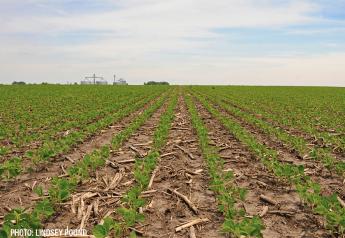
PLANTING INTO VEGETATION -
There is much data to prove that yields will be severely affected when crops
are planted into vegetation, including vegetation that is dying but not
completely dead. This is especially true in corn and in soybeans where
farmers have typically thought they could burndown immediately in front of
or even behind the planter with no adverse effects on the crop.
As
much as a 20% decrease in crop yields of grain crops has been proven when
such weed management is abused in such a manner. Fields should have only
dead vegetation present for at least three weeks in advance of planting.
That means that most burndown should be applied at least 6 weeks in advance
of planting. Most farmers are waiting much too long before applying
burndown.
Rain and wind has prevented some farmers from getting
burndown out in a timely manner. Some have applied burndown to acres
intended for corn the past few days. Erratic stands will be the norm in
these fields unless that vegetation is removed prior to planting.
Using a drag in front would help, but most rows are too short for that.
Waiting another two weeks may be the better alternative.
Planting the third week of March would be better than planting into a
freshly-treated field of winter vegetation.
WEATHER – Four days
without rain. Three full of sunshine. And very little wind. Many farmers
finally got burndown out.
Unfortunately rain is forecast for most of this week
beginning tomorrow.
Ground temps still much too cold to plant corn, but we
think some folks may have started anyway. Some tillage on Macon Ridge soils
and ultra-light ridges, but majority of land still much too wet for tillage.
BURNDOWN – Applicators
and farmers should be aware of wheat fields in the area when applying
burndown. Glyphosate can drift miles and miles when conditions are wrong.
Some wheat has already been hit with glyphosate drift. Even though visual
symptoms may not be present, glyphosate can cause massive yield losses. If
symptoms are not apparent, but glyphosate-drift may be of concern from any
certain nearby applications, leaf samples should be taken immediately and
sent to a lab for analysis.
We suggest that farmers and landowners first try to work
out suspected drift complaints through the suspected aerial or ground
applicator before turning in such claims to the state. Many times the
situation can be resolved before filing a complaint with the LDAF. This
reduces the number of complaints that must be turned into EPA and helps
relieve us of future regulations that may be coming if too many complaints
are turned in.
WHEAT – Wheat still
looks weathered. But the sunshine and warmer temps are allowing fields to
finally grow so they resemble wheat fields instead of a field of winter
weeds.
All wheat has been fertilized. No disease issues at
present.
COTTON – Cotton acreage
continuing to climb. Some farmers who have not planted cotton in several
years have now committed to planting the “white crop”.
Landowners also having a pivotal role in helping to
increase cotton acres. Some are offering rent considerations in exchange for
more cotton on their farms.
Don’t forget the seed treatment. And don’t forget the
Orthene on the seed.
Still getting calls about what varieties we will
recommend this year if 555 or 515 was unavailable. Here is a list and not
necessarily in the order that we would recommend them, but we will say that
we have more good experience with ST 5288B2F than the others. The list is:
ST 5288BRF, PHY 485WF, PHY 565WF, DPL 1050B2F, DPL 1048B2F, DPL161B2F.
We will be working again with Monsanto this year with
small plots of their new class of 2011 cotton varieties. We are also working
with Bayer on their FiberMax and Stoneville varieties and hope to have Dow’s
varieties also in our trials, but this has yet to be confirmed.
CORN – Some corn may
have been planted the past two days. Ground temps still 8 – 10 degrees from
being comfortable for a corn seed. Will warm quickly where refuse is not
thick. The darker the soil the better it will warm. Heavy clay soils will
generally be 5 degrees warmer at 9:00 AM in the morning than silt loam
soils.
One farmer commented that if we put corn in the ground
now it will eventually come up. Well, remember last year. We had very
similar weather and the corn did not come up. Rainy and cold. Over 70% of
the early-planted corn was replanted in our area last year.
It is still not too late to have a good corn crop if we
use good agronomic practices and plant when ground temps are right. Air
temps can be cold as long as ground temps are 55 or above - corn can
survive. Of course, 60 is better.
It is not too early to consider side-dressing with
nitrogen. Applying 100% of nitrogen by the time corn is in the 5th true
leave stage is the norm in our area. But that does not make it the best
method. We are encouraging farmers who apply 200 units of N total to apply
150 – 160 units early and then fly out 100 lbs of urea with Agrotain/acre at
pre-tassel. It makes much more efficient use of N than applying it all at
once to a crop that doesn’t need it for another 6 weeks.
If one prefers to knife it all in then split it and
apply 120 – 130 lbs of N /ac early and the remainder with one knife per
middle at lay-by.
Even though some farmers have been farming corn a long
time, we are still relatively new to corn. It likes nitrogen, but in a
timely manner. Don’t forget the zinc and sulfur, especially on the lighter
soils. The addition of zinc to starter fertilizer is a must on many soils.
There is one particular brand of zinc we recommend. Call us for a
recommendation.
We will again work with Derek Scroggs with Pioneer’s
corn varieties. We hope to have Terral’s and Monsanto’s (DPL and Asgrow)
varieties in similar trials, but have yet to receive the seed.
RICE –We hate to
continue reiterating what we have already stated, but growing rice without
Command should be illegal. There may be some soils that lack enough OM to
use Command as a pre, but it can certainly be applied after the rice has
emerged. If one has had bad experiences with Command, then Prowl is an
alternative. It is not quite as good under wet field conditions, but will
last long enough to give us a clean start.
We keep hearing at rice meetings how rice is limited
with herbicide selections in comparison to other crops. Whoa! We have
been working other crops for many, many years and think that the choices in
rice are far better than ones we have in other crops. The only difference is
the cost. Rice herbicides are much more expensive because they can be. The
market will bear it and the cost of getting a rice herbicide to market is
just as expensive as any other crop, but that cost must be spread over many
fewer acres of rice.
Many farmers have forgotten about propanil. It is still
as good today as it ever was. And it has its place.
SOYBEANS – We will
suggest to several farmers to plant a MG III soybean along the edges of one
or more of fields to be planted to MG V soybeans to determine if we can trap
the Red-banded Stinkbugs (RBSB) in the III’s before they move further into
the V’s.
There are far too many soybean varieties. In a few years
there may be as many as 400 varieties that would need testing. The industry
can support this number of varieties only if the farmers can. One reason
that everyone wants in on the soybean seed business is because that is where
the money is. Not too long ago seed salesmen were considered second class
citizens. Now, they are the most important sales reps we have since the cost
of seed and the delivery mechanism for insect and weed control is being
delivered in the seed itself. The same could be said of all crops, not just
soybeans.
We will again be working with Derek Scroggs and Pioneer
in evaluating some of their best soybean varieties. We hope to have Terral
and other companies in the trials as well, but currently have no commitment
from them.
|